
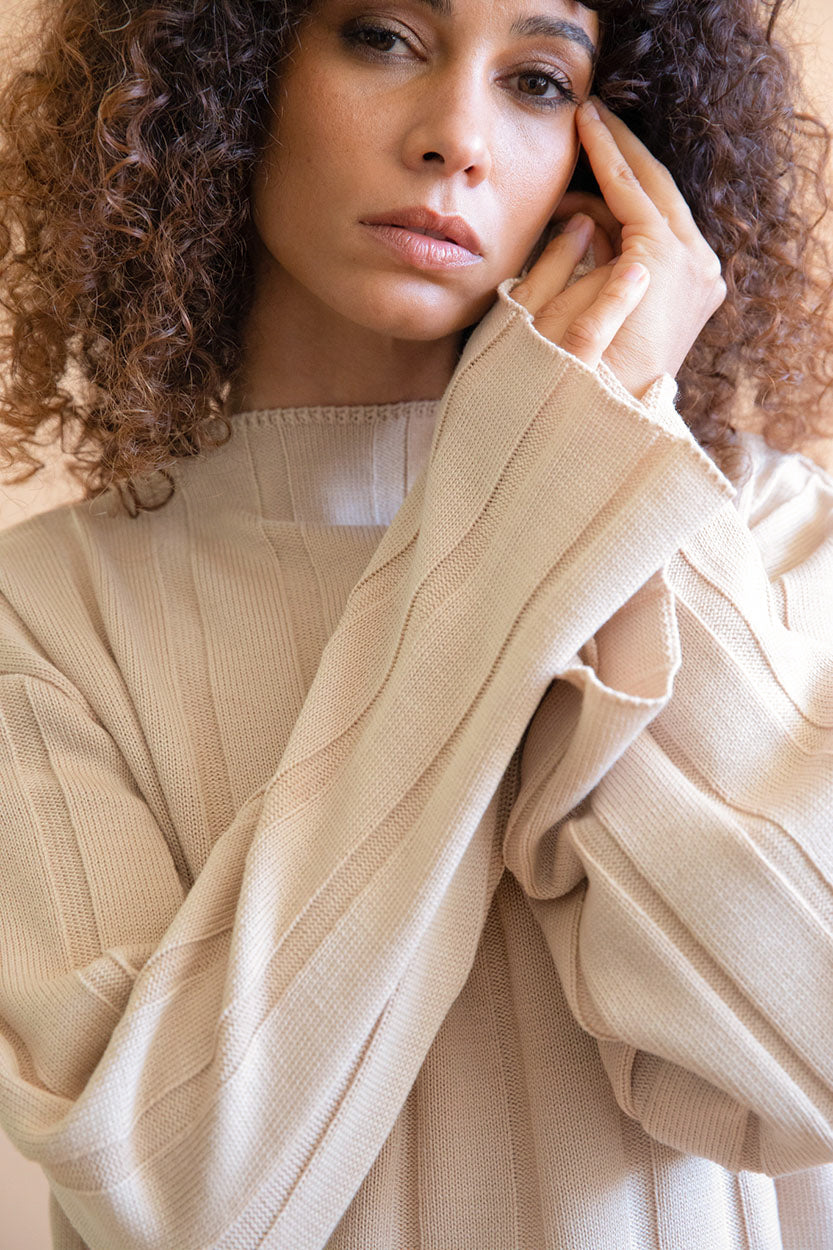


Merino wool is particularly appreciated for the quality of its fibers. Fine, soft and naturally thermoregulating, it does not itch and offers exceptional comfort, even in winter.
Thanks to the keratin it contains, merino wool also has antibacterial properties that help neutralize odors. As a result, a wool sweater requires fewer washes, provided it is cared for properly.
To properly care for a wool sweater, it is essential to respect the natural rhythm of the fiber and of natural materials like those we choose to work with.
Airing your wool sweater: the best habit
After wearing your sweater, there is no need to wash it every time.
The simplest — and most effective — solution is to air it outdoors for a few hours. This helps eliminate odors, preserve the fiber and delay washing.
How to wash a wool sweater: 5 essential rules
When washing becomes necessary, here are the golden rules for washing a wool sweater without damaging it:
- Turn the sweater inside out before washing, ideally placing it in a laundry mesh bag to protect the fibers.
- Use a special wool detergent, in small amounts. Fabric softener should be avoided.
- Select a wool program: cold wash, short cycle and gentle spin.
- Steam iron at low temperature, only if necessary.
- Lay flat to dry, away from heat sources, and never hang it on a hanger to prevent stretching.
These simple steps help maintain the softness and shape of your garment.
Why does a wool sweater pill?
Pilling is often seen as a flaw, when in fact it is a sign of a natural, living fiber. Unlike synthetic fabrics, wool changes over time.
A wool sweater yarn is made up of a mix of long and short fibers. With friction, the shorter fibers rise to the surface and tangle together, forming pills. Once these short fibers are removed, only the longer fibers remain, forming the structure of the sweater.
👉 This is why a wool sweater pills mainly during the first wears, and less and less over time. After several washes, the surface generally becomes more stable.
How to remove pills without damaging wool
To remove pills, simply use:
- a fabric shaver
- or an anti-pilling comb
In just a few minutes, your sweater looks clean and smooth again — without damaging the fiber.
Taking care of your wool sweaters also means extending their lifespan. To truly care for a wool sweater is to accept that the material lives, evolves and develops a natural patina over time — for a garment designed to last, season after season.


